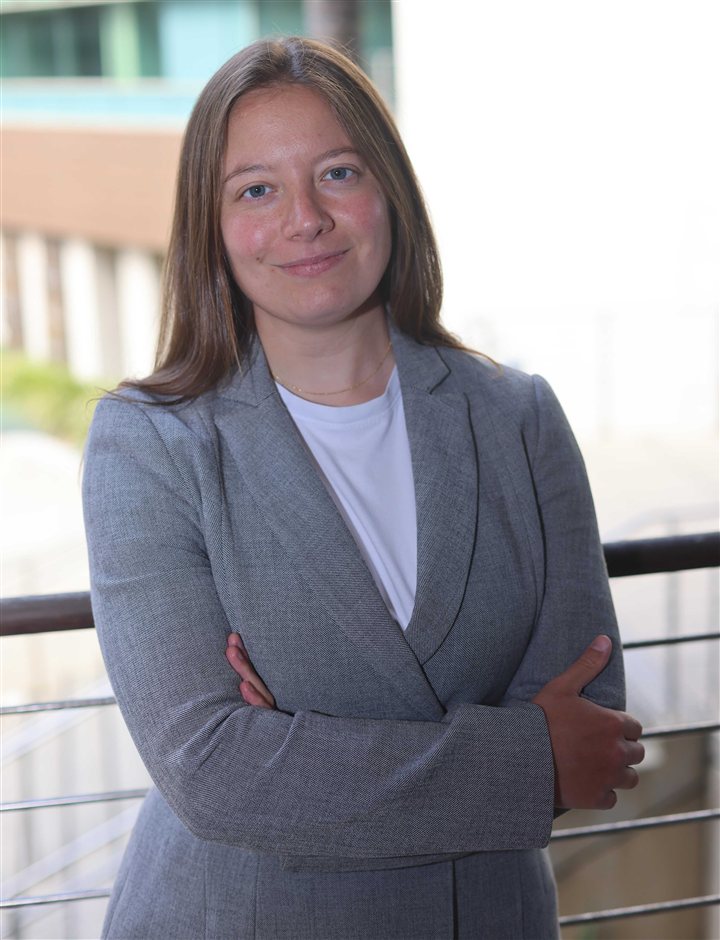
Carolina Raffaelli

Carolina Raffaelli

PhD Candidate in Behavioral Marketing

Rady School of Management, UC San Diego

My research focuses on judgment and decision-making, with a special interest in two areas: Product Usage and Risk/Uncertainty. In the first stream, I study how consumers think about product usage, how these expectations shape consumption utility and purchasing behavior, and how they can be leveraged to promote more sustainable consumption. In the second, I study what information people prefer to receive, and how they prefer to receive it, when facing uncertain decisions.

Before my PhD, I worked as a lab manager at BELSS, the Bocconi Experimental Laboratory for the Social Sciences, and as an intern at Amazon in Milan, Italy. I hold an MS in Marketing Management and a BS in Economics and Finance from Bocconi University.

Peer-Reviewed Publications

Sequential Information Preferences in Uncertain Decision Making

Journal of Experimental Psychology: General

Uma R. Karmarkar, John A. Clithero, Carolina Raffaelli

2026 PDF
Although decisions often appear instantaneous, they can unfold dynamically with sequential processing of different types of information. Prior research finds that the order of considering risks versus rewards in uncertain decisions can influence the perceived value of a financial prospect. However, it remains unclear which information people might choose to learn first for themselves. Across eleven preregistered experiments (N = 6709 adult participants from in-person and online pools), we demonstrate that a majority of people prefer to consider risks before rewards. This preference is associated with individual sensitivity to economic ambiguity, but not a general need for structure. We further show that self-selected sequences are useful not only for predicting information seeking behavior in financial and marketplace contexts, but also for predicting downstream behavior in terms of choice process and choice outcomes.

BRAND: Brand Recognition and Attitude Norms Database

Behavior Research Methods

Carolina Raffaelli, Elena Bocchi, Zachary Estes, James S. Adelman

2025 PDF
Research involving brands has increased substantially in recent decades. Yet, there is no extensive and free dataset of consumer responses to branding stimuli. The present research develops and validates such a dataset, which we call the Brand Recognition and Attitude Norms Database (BRAND). BRAND is the most comprehensive set of methodologically transparent, freely-available, research-relevant consumer responses to branding stimuli, with measures of familiarity (awareness), liking (attitudes), and memory (recognition) of more than 500 top brands and their logos, spanning 32 industries. BRAND includes 5,356 primary datapoints aggregated from 244,400 raw datapoints collected from 2000 US-resident consumers in two years (i.e., 2020 and 2024). The data exhibit good reliability, face validity, external validity, robustness across samples and time, cross-validity, and discriminant validity. BRAND can be broadly useful for testing hypotheses involving responses to brands, and for selecting stimuli in any study involving brands or logos.

Working Papers

How Long and How Often: Asymmetric Drivers of Usage Happiness

Carolina Raffaelli, Wendy Liu

Under Review Job Market Paper MSI Doctoral Dissertation Competition Honorable Mention (2026)
Marketers are increasingly focused on promoting greater product usage after purchase, which is beneficial to consumers and the environment if it reduces excessive purchases. Yet how do people subjectively evaluate the total usage of a product? In particular, when considering how happy they would be with total usage, do people weigh the expected duration and frequency of use equally, when the two dimensions make the same objective contribution to total usage and cost-per-use? This research finds that consumers are more sensitive and give greater weight to usage duration than usage frequency. We posit this asymmetry is partly driven by differences in the strength of consumers' prior expectations, due to differential associations with these dimensions. Specifically, people associate usage frequency with mainly user characteristics which have diffuse expectations, but associate usage duration with both user and product characteristics that give rise to more inherent baseline expectations. The presence of strong expectations in turn leads to consumers' greater sensitivity to usage duration than frequency. Eight studies provide evidence for this asymmetry and its underlying mechanisms. This research contributes to theories of subjective consumption utility from product usage and has significant managerial implications for how marketers and responsible consumption advocates promote high-usage products.

Stealing Time: Differential Sensitivity and Response to Violations of Time versus Money

Katie Hillegass, Carolina Raffaelli, On Amir

In Preparation for Submission

Selected Research in Progress

Consumption Share Neglect

Carolina Raffaelli, Wendy Liu

Data Collection

Valence and Preferences for Information Under Uncertainty

John A. Clithero, Carolina Raffaelli, Uma R. Karmarkar

Data Collection

Sustainable Clothes Misbeliefs: What Consumers Get Wrong

Carolina Raffaelli, Wendy Liu

Data Collection